TL;DR:
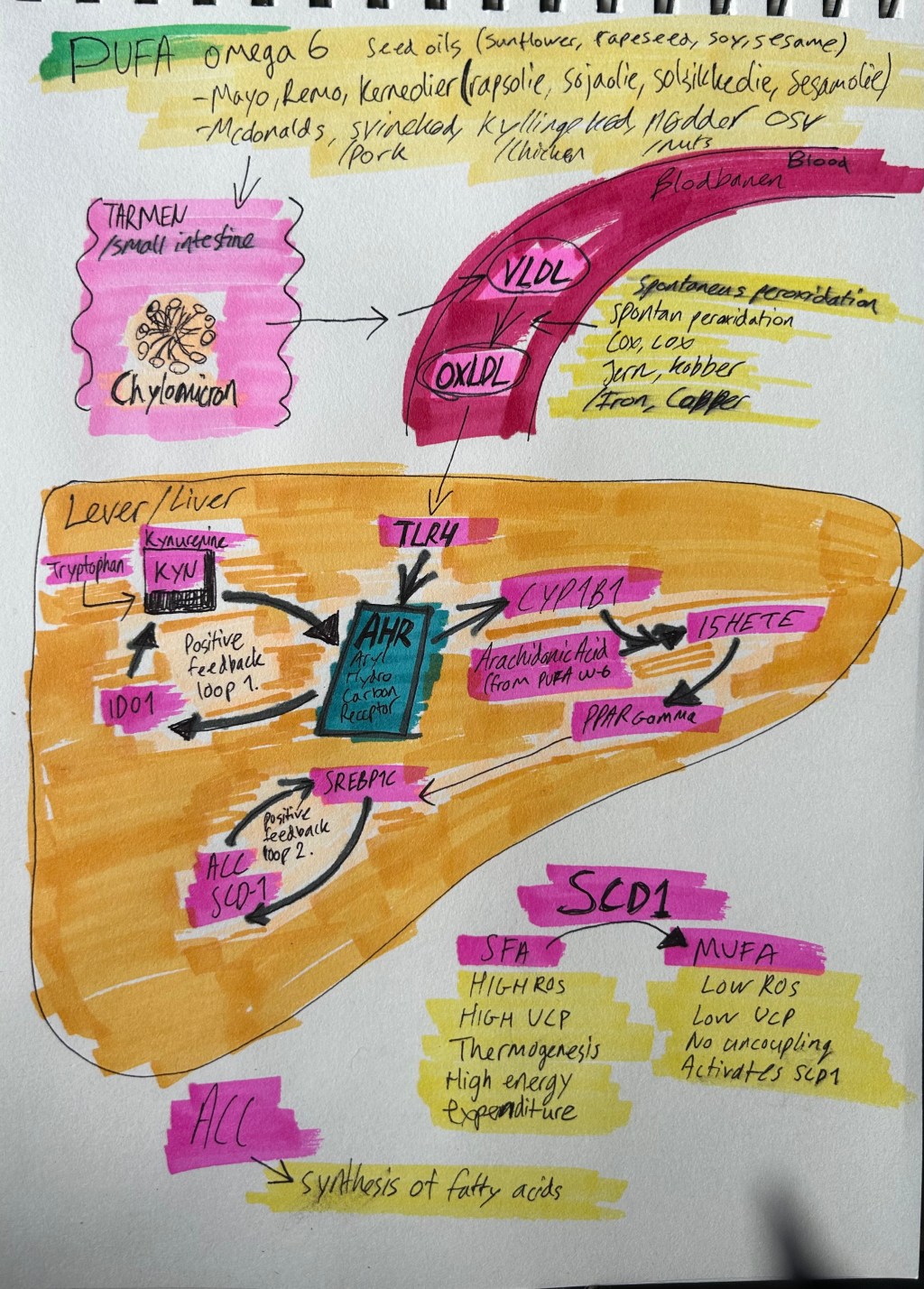
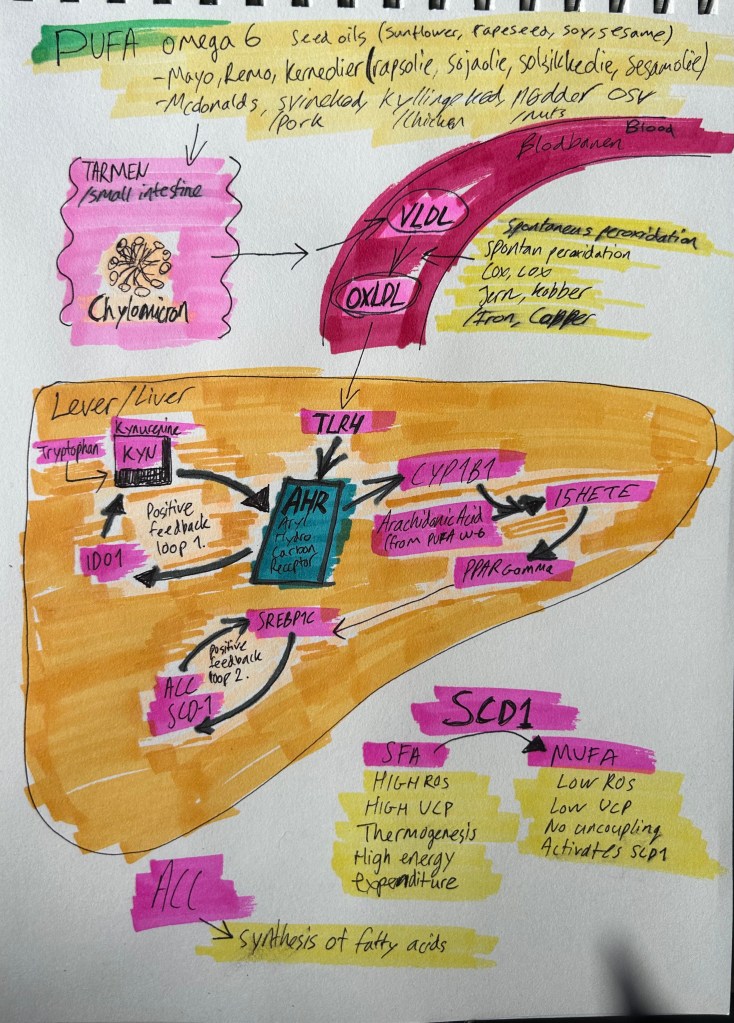
PUFA induces af stress response in the liver that turns on the aryl hydrocarbon receptor AHR.
This turns up transctiption of the fat storage programming, which down the line acts to increase transcription of SCD1 and other fat storage/lipogenic enzymes – SCD1 turns Saturated fats to monounsatured fats, and now the metabolic rate slows down by way of burning monounsaturated fats instead of Saturated fats, probably because of a decreased amount of super oxide /ROS production from Mono unsaturated fat combustion. The cell now produces less heat and lowers energy expenditure, because uncoupling proteins are not upregulated, and the cell becomes more reduced in terms of the electron carrier redox balance, which slows down metabolic rate further.
This could be interpreted as PUFA, being a signal of the winter to come and the animal, including humans, to go into fat storage and hibernation mode.
TL;DR IN DANISH:
Flerumættede fedtsyrer inducerer et stressrespons i leveren, som aktiverer aryl hydrocarbonreceptoren AHR. Dette øger transskriptionen af fedtlagringsprogrammeringen, som senere fører til øget transskription af SCD1 og andre fedtlagrings/lipogene enzymer. SCD1 omdanner mættede fedtsyrer til monoumættede fedtsyrer, og den metaboliske rate sænkes, fordi der forbrændes monoumættede fedtsyrer i stedet for mættede fedtsyrer, sandsynligvis på grund af en reduceret mængde superoxid/ROS-produktion fra forbrændingen af monoumættet fedt. Cellen producerer nu mindre varme og reducerer energiforbruget, fordi afkoblingsproteiner ikke opreguleres, og cellen kommer ind i en mere reduceret tilstand, med hensyn til redox balancen af elektronbærere, hvilket yderligere sænker den metaboliske rate.Dette kunne tolkes som, at PUFA fungerer som et signal til pattedyr om, at vinteren er på vej, og at dyret, herunder mennesker, skal gå ind i en tilstand af fedtlagring og dvale.
Liver enzymes
While the greater degree of unsaturation of the tissue and membrane fats are great for surviving cold winters or ice ages, by making the cells less likely to solidify in cold temperatures – and slows down metabolism to make the animal more likely to survive long peroids of low food supply
-they are probably highly detrimental to the health of modern man.
Here’s one of the mechanisms of which polyunsaturated fatty acids, the original mammalian hibernation induction molecule, is related to modern disease phenomena:
PUFA Upregulates the SCD1 enzyme through the aryl hydrocarbon receptor AHR, which senses the oxidised PUFA in the LDL molecules (oxidation caused by PUFA metabolites), as an environmental toxin not much unlike the way it senses other environmental toxins such as dioxin. Blocking the Aryl Hydrocarbon receptor, and thereby SCD1 activity, seems to “prevent western diet induced obesity in mice”
Inhibition of the aryl hydrocarbon receptor prevents Western diet-induced obesity. Model for AHR activation by kynurenine via oxidized-LDL, TLR2/4, TGFβ, and IDO1
SCD1 converts saturated fatty acids into mono unsaturated fatty acids and seems to be overexpressed in obese humans: Elevated stearoyl-CoA desaturase-1 expression in skeletal muscle contributes to abnormal fatty acid partitioning in obese humans
The function of SCD1 is to turn Saturated Fatty Acids (SFA) into monounsaturated Fatty Acids (MUFA) https://www.jlr.org/article/S0022-2275(20)35139-7/fulltext
– This slows down metabolic rate by NOT producing as much reactive oxygen species at the electron transport chain, by mechanisms that are still to be understood exactly)
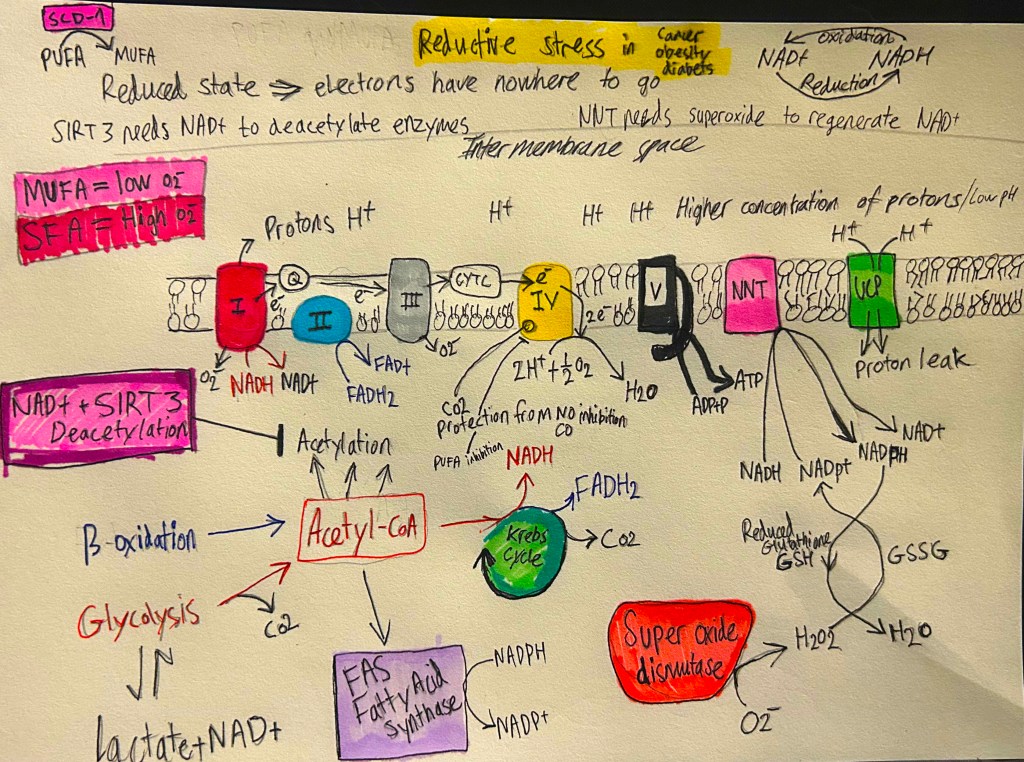
The relatively lower production of ROS from MUFA compared to that from Saturated fatty acids, fails to upregulate the Uncoupling Protein, UCP 1 driven by a transcription factor called NRF2. “Nrf2 activation increases Ucp1 expression in adipocytes… An increase in oxidative stress due to the generation of ROS leads to the activation of Nrf2 “
NRF2 also increases the browning of white fat cells.
Reductive stress and uncoupling
UCP1 lowers the proton gradient between the intermembrane space and the mitochondrial matrix, by letting protons get out of the intermembrane space, out to the mitochondrial matrix without feeding the ATP synthase with energy. This is called uncoupling of the oxidative phosphorylation and the ATP generation. When the uncoupling lowers the proton gradient, it will force the mitochondrial enzymes to work at a faster rate to keep up the proton gradient, replenish NAD+ (and FADH2) faster. In the increase of enzymatic activity, heat is also produced to a higher degree. This increases the body temperature, and the metabolic rate – The calories eaten from burning SFA are dissipated as heat to a higher degree than burning the same amount of calories from MUFA.
The Lower amount of ROS from MUFA oxidation, also fails to feed the superoxide dismutase with superoxide, which oxidises Nicotinamide Adenine Dinucletoide Phosphate (NADPH) back to NADP+.
This NADP+ feeds into another enzyme in the mitochondrial membrane, NNT (nicotinamide nucleotide transhydrogenasenicotinamide nucleotide transhydrogenase)- which in turn oxidises the NADH into NAD+ and thereby counteracts the highly reductive state in the cell seen in the hibernating animal, the obese human or in the cancer cell for that matter.
Failing to get out of the reductive state would slow down metabolism further –
One way of which the impaired electron flow, or failed oxidation of electron transporters NADH, would compromise the metabolic rate further, is by accumulation of Acetyl-CoA, which is one of the earlier steps in the chain of energy production. When the flow stops down the line, it also stops further back. When the Krebs Cycle has no NAD+ to reduce with the electrons from Acetyl-Coa, Acetyl-coa tends to accumulate. Acetyl-CoA would have to deliver electrons somewhere, and it can do so by delivering electrons to the Fatty acid synthase complex, generation new fats, along with oxidation of NADPH.
But accumulation of NADH, and thereby Acetyl-CoA also happens to acetylate mitochondrial enzymes.
This makes the mitochindrial enzymes change rate of enzyme activity and slow down the electron flow and thereby the metabolic rate. Such phenomenon has been observed in rat studies where “accumulated NADH in mitochondria repressed mitochondrial SIRT3 activity leading to hyperacetylation of mitochondrial proteins… these results support that reductive stress induced by high NADH/NAD+ impairs mitochondrial function and energy metabolism in the heart.”
The enzyme SIRT3 as mentioned, functions as a De-acetalyzer of the mitchondrial enzymes, and can upregulate the metabolic rate once again, when the enzymes don’t have the inhibiting acetyl groups attached. But SIRT 3 can only function if it has NAD+, the oxidesed form of the electron carrier NAD.
So where do the electrons go? In the aforementioned study on rat hearts, the electrons were freed
The get through the energy chain more slowly, the animals gets fat (by the electrons going toward fatty acid synthase), and the animal gets very cold and goes into torpor – the metabolic state of hibernation, and probably also human obesity.
It happens that polyunsaturated fats, especially omega-6 linoleic acid, is a biochemical signal for animals to fatten up, enter the torpor metabolism, and go into hibernation.
“High dietary PUFA contents were found to increase proneness for torpor, decrease body temperatures, prolong torpor bout duration, and attenuate hibernation mass loss.”
heavily inspired by https://fireinabottle.net/

 Seabridge Bioenergetics
Leave a reply to Elevated Free fatty acids cause of diabetes? – Seabridge Bioenergetics Cancel reply