-
Continue reading →: ADHD -neuroinflammation og neurotransmitterforstyrrelser som følge af lave vitamin D niveauer?
Endnu mere peger i retning af at ADHD fænomenet er en bioenergetisk forstyrrelse – denne her gang er d vitamin mangel et muligt interessant emne at undersøge SDU’s børne kohorte har vist at der er en sammenhæng mellem moderens vitamin d niveau i graviditeten, og barnets grad af adhd symptomer:…
-
Continue reading →: ADHD – B6 vitamin mangel – ophør af symptomer ved behandling med B6
Neurotransmitter forstyrrelserne man ser i ADHD fænomenet kan være relateret til b6 vitamin mangel – mange af de neurtransmittere der er forstyrrelser i ved ADHD fænomenet er alle afhængige af b6 som coenzym ved deres syntese. “Since dopamine, noradrenalin, serotonin, glutamate, GABA are formed or metabolized by PLP-dependent enzymes (Fig.…
-
Continue reading →: – PUFA på banen igen – involveret i ADHD patologi?
Meta analyse omkring omega 6/ omega 3 ratio – det findes at folk med adhd fænomenet i højere grad end baggrundsbefolkningen har en høj omega 6 /omega 3 ratio. Dvs de har højere mængder af de flerumættede olier af omega 6 typen. Studiets konklusion: “Children and youth with ADHD have…
-
Continue reading →: Why are PUFA’s so bad?
Health authorities and patient organizations all say we should eat PUFA – of which some of them are the worst metabolic toxins and promotors of aging and disease. This tweet from Nassim Taleb inspired me to do look at some studies showcasing the dangers of too much poly unsaturated fatty…
-
Continue reading →: Vitamin D. Anticancer, performance enhancing, anti inflammation, antidepressive, antiviral, anti-aromatase, anti pufa.
The winter is upon us, and vitamin D stores will get low through the winter here in the northern countries, where the sun rarely smiles at us, and in an angle, that is not sharp enough to stimulate keratinocytes to produce vitamin D. I believe that many, if not most…
-
Continue reading →: Targeting reductive stress programming in cancer – a probable relationship to several cancer hallmarks
First some prose and background from my understanding of cancer metabolism- and then a look at a new study on targeting reductive stress in cancer. Lastly, a small look into some probable methods of getting the cell out of the highly reduced state. Now we know that the hibernating and…
-
Continue reading →: ALAN (artificial light at night) exposure associated with type 2 diabetes
In a 2024 review in Diabetes and metabolism journal, the link between ALAN and type 2 diabetes is reviewed. Seems staying awake at night with the lights of modernity messes with everything from glucose metabolism and circadian rythm, to the life style choices that “night owl” chronotypes make. “For example,…
-
 Continue reading →: Lactate rise under aerobic conditions.
The disease vortex agents in human Biology In my personal view, the disease vortex agents in human biochemistry consists of some of the following elements: Today, we are going to look at how lactate can be produced and significantly elevated even under fully aerobic conditions. A Danish study from 2003,…
-
 Continue reading →: Elevated Free fatty acids cause of diabetes?
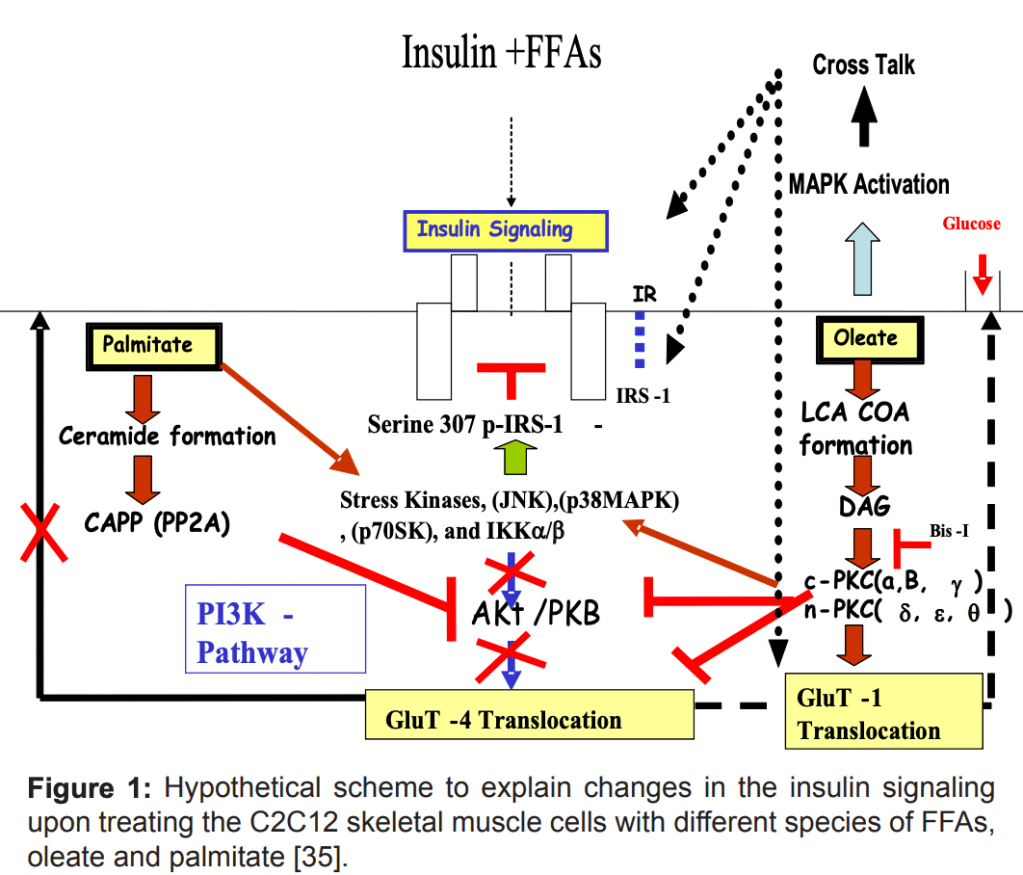
Background on Type 2 Diabetes Type 2 diabetes is broadly defined as a combination of insulin resistance and beta-cell dysfunction, where insulin signalling and production becomes insufficient. Before reaching the stage of type 2 diabetes, one can experience insulin resistance for years, until the pancreatic function deteriorates to the point…
-
 Continue reading →: Injecting PUFA into rats make them insulin resistant and activates inflammation transcription factor NF-Kappa-Beta
More evidence that polyunsaturated fatty acids, are directly causative in insulin resistance. “In skeletal muscle, FFAs inhibit insulin-stimulated glucose uptake at the level of glucose transport and/or phosphorylation (4,5) through mechanisms that involve intramyocellular accumulation of diacylglycerol (DAG) and long-chain acyl-CoA, activation of protein kinase C (PKC), and decreased tyrosine…

Welcome to my blog about cellular physiology and bioenergetics.
This is where I show you what I find in my search for trying to understand how cellular energy relates to modern disease.
If you like my work, consider supporting me with a cup of coffee (with sugar)
https://buymeacoffee.com/realzeebrugge
- ADHD -neuroinflammation og neurotransmitterforstyrrelser som følge af lave vitamin D niveauer?
- ADHD – B6 vitamin mangel – ophør af symptomer ved behandling med B6
- – PUFA på banen igen – involveret i ADHD patologi?
- Why are PUFA’s so bad?
- Vitamin D. Anticancer, performance enhancing, anti inflammation, antidepressive, antiviral, anti-aromatase, anti pufa.
 Seabridge Bioenergetics