The winter is upon us, and vitamin D stores will get low through the winter here in the northern countries, where the sun rarely smiles at us, and in an angle, that is not sharp enough to stimulate keratinocytes to produce vitamin D.
I believe that many, if not most diseases have the same root patterns – impaired energy production , which impairs function – inflammation – which impairs energy production and structure. All are some how related.
So when a vitamin such as Vitamin D has so broad effects on so many apperently unrelated systems and diseases, it makes one think, that they are more related than it seems.
We shall now look at some interesting studies on vitamin D.
First some introduction.
Vitamin D is a steroid hormone, that is produced in the body like this:
Skin. Keratinocyte:
7-dehydroxycholesterol —–UV-B—-> Pre-vitamin D3.
Liver. Hepatocyte:
Pre vitamin D3 —–CYP27A1—–> 25OH-D3
Kidney:
25OH-D3 ——- 1alfa-hydroxylase —-> 1.25(OH)2-D3
So we shall call them: PreVitaminD(Cholecalciferol) , 25D (Calcifediol) and 1.25D(Calcitriol).
1.25OH2-D3 is accepted as the active form which has nongenomic and genomic effects, but recent studies suggests that the inactive form, 25OH-D3 also have both transcriptional and nontranscriptional activity. https://www.ncbi.nlm.nih.gov/pmc/articles/PMC8707877/
The main effect of 1.25D is that of increasing calcium absorbtion from the intestine, but it also stimulates calcium reabsorbtion from the kidney’s and it stimulates bone resorption in theory at least – but probably when calcium is plenty and PTH is low, it itself, negatively feeds back to decrease the production of the enzyme 1-alfa-dehydroxylase that produces the 1.25 form to begin with.
But, there are many very interesting studies on how Vitamin D might be very beneficial for humans.
Let’s take a look at some of them:
Mechanisms of the anti-cancer and anti-inflammatory actions of vitamin D.
https://www.semanticscholar.org/paper/Mechanisms-of-the-anti-cancer-and-anti-inflammatory-Krishnan-Feldman/4c26ad6d8865beee59259500db8ec59698083e1d
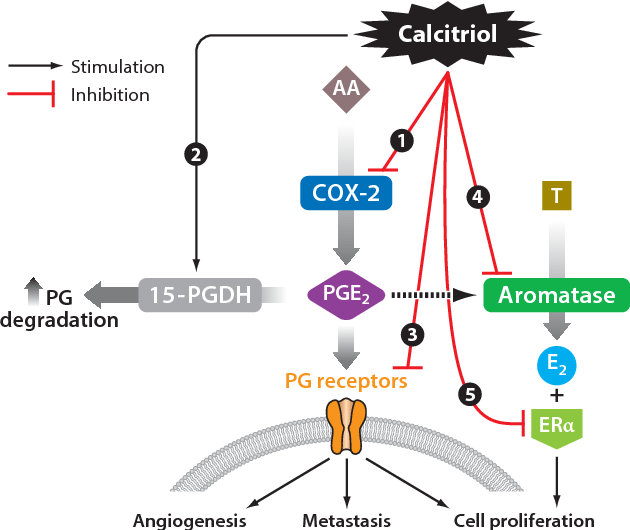
It seems 1.25D blocks some of the actions of PUFA via COX-2 inhibition and at the prostaglandin receptor level.
Also seems to inhibit aromatase activity to block the effects of too much estrogen. Estrogen’s normal function in the body is to cause quick proliferation in the endometrium and in the the embryo, but is is also associated with proliferation in cancers.
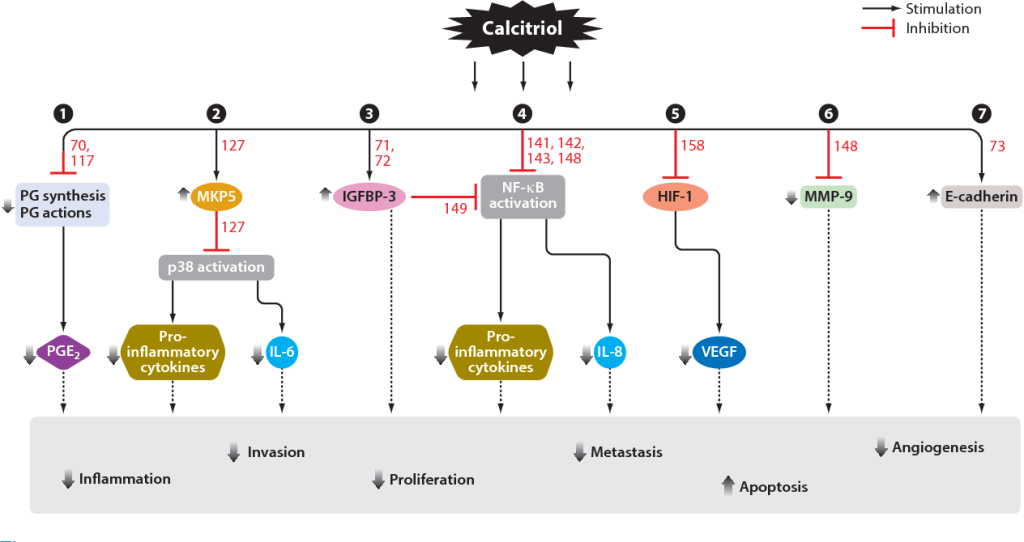
“Calcitriol exerts multiple anti-proliferative, pro-apoptotic, and pro-differentiating actions on various malignant cells and retards tumor growth in animal models of cancer. Calcitriol also exhibits several anti-inflammatory effects including suppression of prostaglandin (PG) action, inhibition of p38 stress kinase signaling, and the subsequent production of pro-inflammatory cytokines and inhibition of NF-κB signaling. Calcitriol also decreases the expression of aromatase, the enzyme that catalyzes estrogen synthesis in breast cancer, both by a direct transcriptional repression and indirectly by reducing PGs, which are major stimulators of aromatase transcription.”
Vitamin D also seems to be performance enhancing even in elite athletes, according to this litterature review:
Effects of Vitamin D Supplementation in Elite Athletes: A Systematic Review
https://pubmed.ncbi.nlm.nih.gov/38188620/
“Of the 3 studies that assessed aerobic capacity, 2 demonstrated significantly greater improvements in maximal oxygen uptake and physical working capacity-170 (P < .05) in supplemented versus nonsupplemented athletes. Measurements of anaerobic power and strength were consistently increased in supplemented groups compared with nonsupplemented groups in 5 out of the 7 studies that assessed this”
Seems that Vitamin D supplementation may be able to increase both aerobic and anaerobic power.
———–
Vitamin D has many interesting non genomic effects, such as inhibiting the major inflammatory pathways such as those activited endotoxin.
The Toll Like Receptor TLR has already been discussed a lot on this blog and how it is associated with the pathological processes in sepsis, cancer, diabetes, autoimmune disease and so on.
The Non-Genomic Actions of Vitamin D
https://www.ncbi.nlm.nih.gov/pmc/articles/PMC4808864/
“Consistent with the in vitro data that 1,25D suppresses inflammatory cytokine production and inhibits NF-κB mediated gene transcription [33,39,40,41,42,43], it has been reported that dietary supplementation of carp with cholecalciferol suppressed lipopolysaccharide-induced production of inflammatory markers, including tumour necrosis factor (TNF)α, IL-1β, IL-6 and IL-8 and this was likely to have been the consequence of a vitamin D-mediated downregulation of Toll-like receptor (TLR) 4, Myeloid differentiation primary response gene (Myd) 88 and NF-κB p65 mRNA expression [57]. In another study, Al-Rasheed et al. [58] reported that dietary supplementation of rats with cholecalciferol suppressed cardiac hypertrophy by down regulating TNF-α production and signalling via the NF-κB pathway as evidenced by a reduction in p65 expression but increased expression of the inhibitory I-κBα at the mRNA level”
——
Seems it might be an effective antidepressant according to this meta-analysis.
The effect of vitamin D supplementation on depressive symptoms in adults: A systematic review and meta‐analysis of randomized controlled trials
https://www.tandfonline.com/doi/full/10.1080/10408398.2022.2096560
“Vitamin D supplementation ≥ 2,000 IU/day appears to reduce depressive symptoms.”
——–
Another time, we shall look more into the vast amount of interesting studies of vitamin d in human health and disease.

 Seabridge Bioenergetics
Leave a comment