We shall now look at how fatty acid combustion causes an impairment in the electron flow and an overweight towards reduction in the redox balance of electron carriers, and how it generates a higher amount of reactive oxygen species when a there is an overweight towards the reductive state in the redox balance. We shall also peek at how this increased cell stress from excess lipolysis and impaired glucose metabolism might be involved in modern diseases such as cancer and diabetes.
Beta-oxidation, lipolysis, and fatty acid oxidation are used interchangeably for the same process of burning fat as fuel. Glycolysis/sugar burning/glucose oxidation and oxidative phosphorylation of glucose are used interchangeably and should not be understood as anaerobic glycolysis. Anaerobic glycolysis is where the end product of glycolysis is lactate instead of acetyl-coa – so that the electrons are flowing away from the Krebs cycle in order to regenerate NAD+ (electron carrier) and create ATP without oxidative phosphorylation.
Health-conscious parents and school teachers are going crazy with their zero-sugar policies. At the same time, it’s more fashionable than ever to starve oneself. “No thanks, no croissants for me, I’m fasting,” you often hear the middle-manager types say, but now there is evidence suggesting that burning glucose is a cleaner and more energy-providing form of combustion than burning fat. At the same time, excessive fatty acid burning is one of the hallmarks of the cancer and diabetes phenomena (among many other modern disease phenomena).
We shall argue that over baseline fatty acid oxidation might itself be a direct cause of insulin resistance and high fatty acid levels in the blood might impair glucose metabolism by itself.
Let’s delve into the biochemistry and see how beta-oxidation of fatty acids generates more free radicals than the glycolytic pathway.
Mitochondrial production of free radicals, which we will call ROS (Reactive Oxygen Species) for the rest of the article is, as mentioned, involved in virtually all modern common diseases such as cancer, cardiovascular diseases, diabetes, Alzheimer’s, infections, and many others. Not necessarily in a direct maner, but because of a more reductive state in the redox balance, where the balance is shiftet towards reduction in the NAD+/NADH and FAD/FAD2H ratio, meaning that electron flow through the glycolysis, krebs cycle and electron trasnport chain becomes impaired. When the electron flow is impaired, there is a tendency to create damaging highly reactive molecules, that interact with proteins, and fatty acids in the cell membrane, impairing function.
“Mitochondrial dysfunction and associated excessive levels of mtROS are major supporters of inflammation [32] that drive the pathogenesis of many diseases, including neurodegenerative disorders, cancer, viral and bacterial infections, cardiovascular diseases, metabolic syndromes, and autoimmune disorders [31]” https://www.ncbi.nlm.nih.gov/pmc/articles/PMC10094238/#:~:text=Mitochondrial%20dysfunction%20and%20associated%20excessive,and%20autoimmune%20disorders%20%5B31%5D.
Mitochondrial damage from free radical damage is the main source of inflammation in cells. Mitochondrial ROS and, consequently from the subsequent programmed cell death, mitochondrial DNA, are the main signaling pathways for the activation of the inflammasome. https://www.nature.com/articles/s41577-022-00760-x
Cancer and diabetes:
Increased lipolysis/fatty acid oxidation is a hallmark of diseases such as diabetes and cancer.
“Adipocyte lipolysis is implicated in diseases such as diabetes, fatty liver disease, and cancer. In diseased states, excessive fatty acids (FAs) activate signaling in surrounding cells to further increase lipolysis in adipocytes, forming a vicious, positive feedback loop”
When insulin signalling is impaired from excess fatty acids in the blood, adipocytes lose their ability to store excess fat in the tissue. Insulin would normally activate fat storage via fatty acid synthase, and suppress fat cumbustion. In this way, fat storage is a “safe way” to get the excess electrons away from the krebs cycle and electron transport chain.
But in insulin resistant states, a vicious cycle where free fatty acids make cells more insulin resistant, so that glucose cannot be oxidised sufficiently – causing that excess glucose to be converted to fat and be stored not in the fat tissue – but instead they are stored in the liver and pancreas, causing even more metabolic problems. At the same time, because of a low energy state and increased fatty acid oxidation, there is an allosteric upregulation of pyruvate carboxylase from excess acetyl-coa from fatty acid synthesis. This is the start of gluconeogenesis in the liver, directly from acetyl-CoA from the increased lipolysis.
In short: Decreased insulin signalling means more fat burning, causing gluconeogensis, and causing fat deposit into the organs causing impaired insulin production
Increased fatty acid oxidation in type 2 diabetes due to insufficient suppression of fatty acid burning by insulin, which has reduced function, leads to not only increased fatty acid synthesis but also increased glucose production. Increased lipolysis AND increased gluconeogenesis – creating new glucose that cannot be sufficiently used in muscle tissue- the recipe for type 2 diabetes.
In cancer, there is also an increase in lipolytic enzymes and increased lipolysis in the cancer microenvironment, and perhaps this increased excessive lipolysis contributes to the cachexia we see as one of the hallmarks of cancer. https://www.ncbi.nlm.nih.gov/pmc/articles/PMC7187988/#:~:text=Adipocyte%20lipolysis%20is%20implicated%20in,a%20vicious%2C%20positive%20feedback%20loop.
In short, one of the mechanisms in many modern medical diseases is increased lipolysis/fatty acid oxidation and decreased oxidative phosphorylation of glucose.
We will now see how fatty acid oxidation is more inflammation-promoting, but also how it, in a positive feedback loop, almost keeps itself going in a form of inertia.
FAD2H, NADH, electron transport chain
We will now see why beta-oxidation generates more free radicals damage from an impairement of electronflow in the electron transport chain.
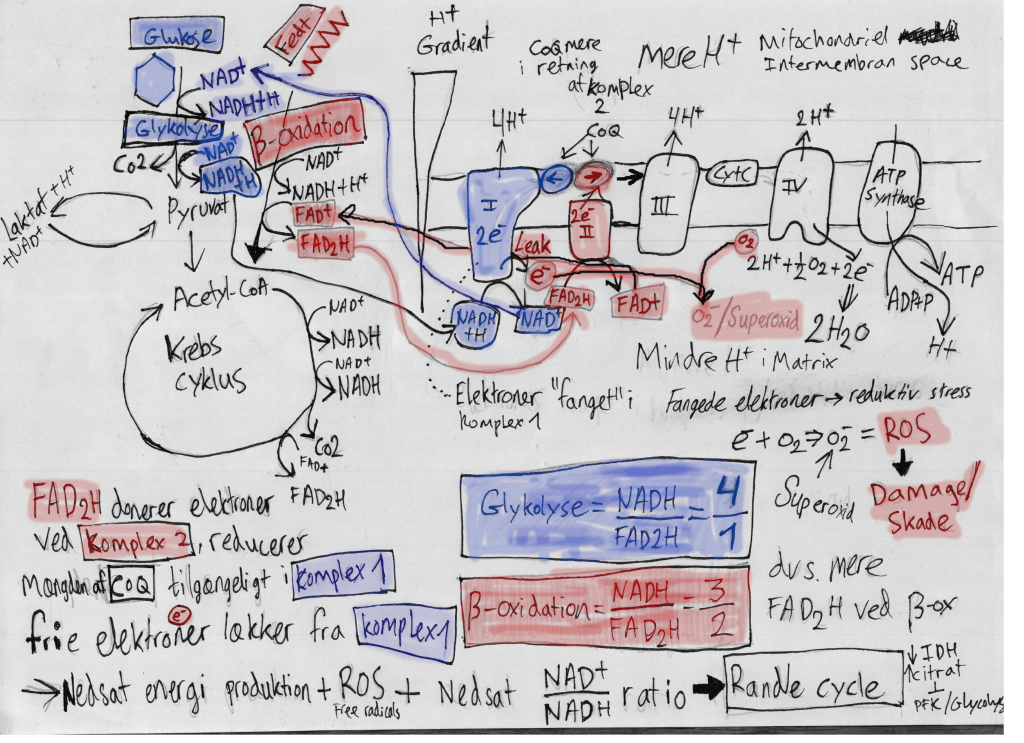
When electrons pass from fatty acid oxidation to the Krebs cycle, relatively more electrons are donated to FAD2H compared to NADH than in glycolysis. We see a net balance that roughly gives 25% more NADH and 50% less FAD2H in glycolysis compared to beta-oxidation.
This has consequences downstream in the electron transport chain, where Coenzyme Q has a greater tendency to move towards complex 2, as there is now a relatively greater electron flow through complex 2. This means that the limiting factor, CoQ, cannot accept electrons sufficiently at complex 1, and this means that there are electrons “trapped” at complex 1 from where they leak and find an oxygen molecule that has vacant seats in the outer orbitals. In this way, a highly reactive form of oxygen is formed, with a negative charge, which we call O2minus or superoxide, which we can call a free radical or ROS. If too much free radical is formed that is not reduced by antioxidants or available NAD+/FAD, it can damage protein structures in the cell, cell walls, and much more, leading to cell damage and inflammasome activation. https://pubmed.ncbi.nlm.nih.gov/30512221/
In short – fatty acid oxidation causes more FAD2H relative to NADH, which pulls CoQ more towards complex 2 and causes electron leakage at complex 1, leading to ROS formation.
NADH then cannot sufficiently deliver it’s electrons to complex 1, and thus the NAD+/NADH ratio falls – this reduces energy production because there is now, relatively speaking, a lack of NAD+ as an electron acceptor upstream in the energy chain. The excess NADH can now not sufficiently deliver electrons in the electron transport chain, and instead must deliver electron en the anaerobic glycolytic pathway creating lactate and oxidising NADH back to NAD+, or it can go to the fatty acid synthase pathway, oxidising NADH to NAD+ and creating new fatty acids in the process.
So excess fatty acid oxidation can cause excess lactate formation and excess fatty acid synthesis because of the reductive stress from excess lipolysis.
The reduced NAD+/NADH ratio also activates the Randle cycle’s preference for fatty acid oxidation – a kind of vicious cycle/self-reinforcing disease vortex, where the reduced pace in the Krebs cycle causes citrate levels to rise, which inhibits Phosphofructokinase/PFK, the bottleneck in glycolysis, while there is an accumulation of acetyl-CoA. https://pubmed.ncbi.nlm.nih.gov/19531645/ Thus, a reduced NAD+/NADH ratio, which is a function of increased fatty acid oxidation, contributes to inhibiting glucose combustion, and thus the process is in a way self-sustaining. This confirms the Randle cycle, which postulates that beta-oxidation slows down glycolysis and vice versa. We will look at Randle in more detail another time.
Some speculate that the reason the brian prefers glucose for combustion, is because it is a cleaner form of energy, creating less free radical damage and inflammation – https://pubmed.ncbi.nlm.nih.gov/23921897/
It also seems to be confirmed in a mice study, that a high fat diet causes inhibtion of mitochondrial energy production, from the associated increase in ROS. https://www.sciencedirect.com/science/article/abs/pii/S0168827810007944
So, to return to the health-conscious parents and the keto/carnivore crowd, as well as the fasting middle managers (who can’t help but point out that they are fasting), it seems that lipolysis/fatty acid burning is a “dirtier” form of combustion than glucose burning. More free radical damage from more reductive stress in the form of increased NADH relative to NAD+. And yes, as mentioned, the suppression of the cleaner sugar combustion is involved in all sorts of modern diseases.
Thank you for reading along!

 Seabridge Bioenergetics
Leave a comment